Multi-tenancy isolation and Postgres row-level security
Row security puts the tenant filter inside the database, for every role except the table's owner, superusers and bypassers.
Predict first
Before you read: predict
ExamHall keeps every university's attempts in one shared table. A migration, run as the login examhall_app, did this:
CREATE TABLE attempts (id int PRIMARY KEY, university_id text NOT NULL, score int);
ALTER TABLE attempts ENABLE ROW LEVEL SECURITY;
CREATE POLICY university_isolation ON attempts
  USING (university_id = current_setting('app.university', true));
The table holds 3 attempts of uni-a and 5 of uni-b. The API logs in as examhall_app too. For a uni-a proctor it runs:
BEGIN;
SELECT set_config('app.university', 'uni-a', true);
SELECT count(*) FROM attempts;
COMMIT;
What does the count return?
The 30-second version
Tenancy is a dial: shared tables with a tenant_id column are cheapest, but one missing WHERE leaks every tenant; a database per tenant isolates and costs more. Row-level security adds a policy to every query on a table. Owners, superusers and BYPASSRLS roles skip it unless the owner is forced, so the API logs in as a role owning nothing.
Row security puts the tenant filter inside the database, for every role except the table's owner, superusers and bypassers.
How it works
Step 1 of 12
tenant_id column cost least; a schema, a database or a whole stack per tenant isolates more and costs more.In the kitchen
- one rack, every item labelled by company; a lockable office; a leased floor with its own mailroom → shared tables with
tenant_id; a schema; a database per tenant (step 1)
Analogy: A coworking space's post rack
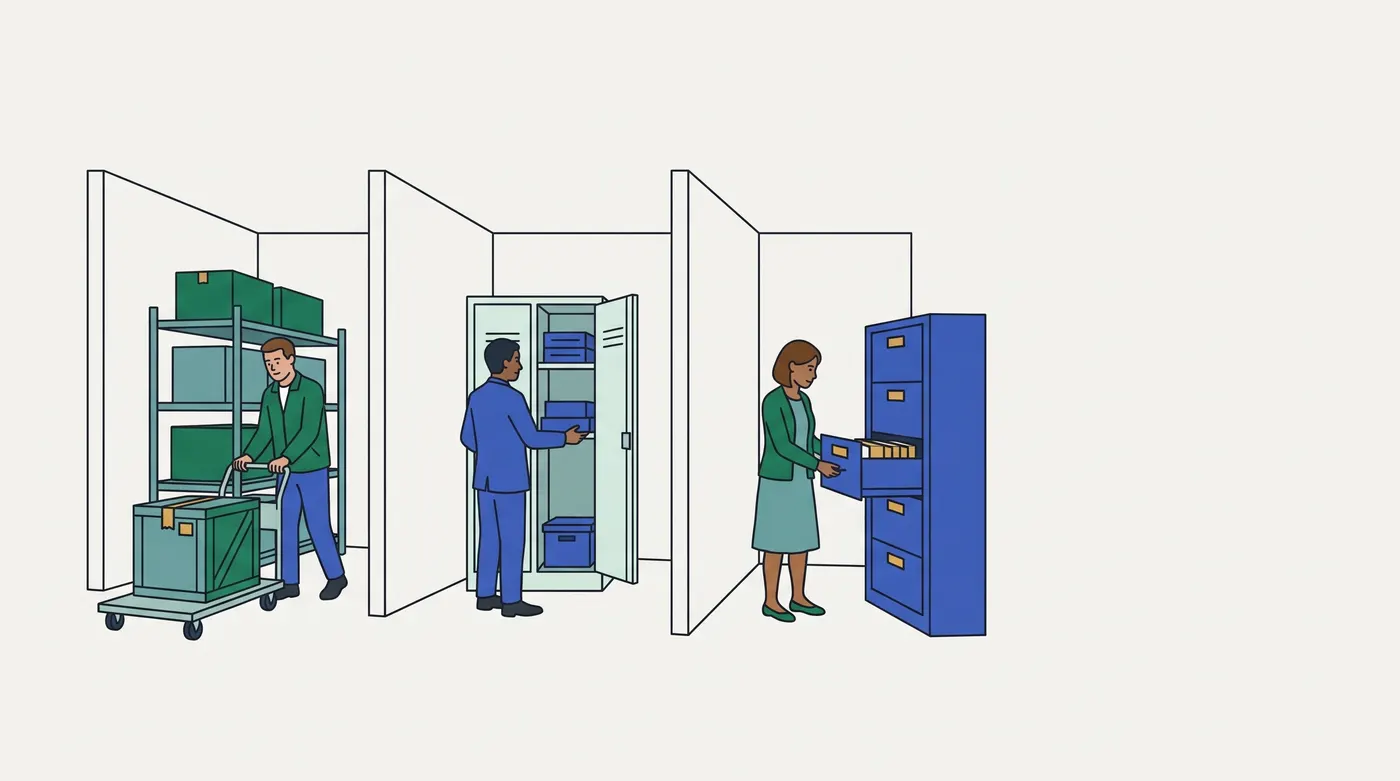
Small companies rent hot desks, and all their post sits in one shared rack, each item labelled with its company. Reception hands a member only the post labelled with the company on that member's line of today's sign-in sheet.
| At the coworking space | In Postgres |
|---|---|
| one rack, every item labelled by company; a lockable office; a leased floor with its own mailroom | shared tables with tenant_id; a schema; a database per tenant (step 1) |
| a house rule pinned up that reception was never told to apply | policies on a table without ENABLE (step 4) |
| reception checks each item's label against today's sign-in line | the policy compares the row with the transaction's setting (steps 4, 9) |
| the operator's staff, who put up the rack, take post freely unless the rules make them sign in | the owner bypasses unless FORCE (step 6) |
| the building's fire officer goes everywhere | superusers and BYPASSRLS (step 6) |
| one company's launch party fills every shared meeting room | a noisy neighbour (step 12) |
Breaks down when: reception sees a person and can ask who they are. Postgres sees only the setting's value, whoever set it, and with no value it returns no rows without a word. Wrong inference: "the database knows which tenant is calling."
Contrasting case: a company on its own floor with its own mailroom: no shared rack, so nothing to filter (a silo, step 2).
In real terms: row security is a WHERE clause the database adds for you, to each query of every role that does not own the table, is not a superuser and lacks BYPASSRLS.
Examples, run for real
4.1 ExamHall EXH-2720: an endpoint without its WHERE
The proctor console's new "recent attempts" endpoint shipped without WHERE university_id = $1, and the API logged in as the migration role. MR !3020 enables row security on attempts with a policy on app.university, moves the API to a login examhall_api that owns nothing, and forces the table so the migration role examhall_owner obeys too. The national exam board keeps its own database, so no policy is involved there (step 2).
4.1 before (no row security, API as examhall_owner): uni-c proctor's list 9 rows · from other universities 6
4.1 after MR !3020 (policy, FORCE, API as examhall_api): uni-c list 3 rows · from other universities 0
4.1 after MR !3020, other logins: examhall_owner 3 rows (forced) · postgres (superuser) 9 rows · a request that sets no university 0 rows
The endpoint still has no WHERE; the policy supplies it (steps 3–4). The superuser still sees everything, so no application traffic logs in as one (step 6).
4.2 Ticketing: a request with no organiser, and the export that needs them all
A box-office platform's orders policy reads app.organiser_id. The nightly export needs every organiser's orders, and a first draft opened a hole in the policy for it:
4.2 box_api, no organiser set · policy as written: 0 rows · with "current_setting(...) IS NULL OR" added: 12 rows of 3 organisers
4.2 export as box_export (BYPASSRLS), policy as written: 12 rows · box_api with no organiser set: 0 rows
The hole lets any request that forgets its setting read every organiser (step 9). A separate login with BYPASSRLS gives the export what it needs, and the API stays closed (step 6).
Picture it
Try it
Answer first, then check. Nothing is saved.
Question 1 of 7
A box-office platform keeps every event organiser's tickets in one tickets table. The table's owner set up:
ALTER TABLE tickets ENABLE ROW LEVEL SECURITY;
CREATE POLICY organiser_isolation ON tickets
  USING (organiser_id = current_setting('app.organiser_id')::int);
GRANT SELECT, UPDATE ON tickets TO box_api;
The API logs in as box_api, which owns nothing. Ticket 5 belongs to organiser 4. Organiser 4's support tool tries to hand it over to organiser 9:
BEGIN;
SELECT set_config('app.organiser_id', '4', true);
UPDATE tickets SET organiser_id = 9 WHERE id = 5;
What does the UPDATE do?
Question 2 of 7
The box-office orders table holds 20,000 orders from 200 organisers, 100 each, with an index on organiser_id. Its owner enabled row security with this policy and ran ANALYZE orders:
CREATE POLICY organiser_isolation ON orders
  USING (organiser_id = current_setting('app.organiser_id')::int);
The API logs in as box_api, which owns nothing. It sets app.organiser_id to 17 for the transaction and runs EXPLAIN SELECT count(*) FROM orders;.
What does the plan show for the organiser check?
Question 3 of 7
The box-office events table has row security enabled and two policies:
CREATE POLICY organiser_isolation ON events
  USING (organiser_id = current_setting('app.organiser_id')::int);
CREATE POLICY published_read ON events FOR SELECT
  USING (published);
Organiser 4 has 5 events, 1 of them published. Organiser 9 has 4, 2 of them published. Organiser 12 has 3, 1 of them published. The API logs in as box_api, which owns nothing, and runs for organiser 4: SELECT count(*) FROM events;.
What does it return?
Question 4 of 7
A box-office platform serves 1,200 small event organisers and one national stadium operator. The stadium's on-sale days bring more load than all the small organisers together.
Which isolation plan fits?
Question 5 of 7
EXH-2721: ExamHall's per-university results report logs in as examhall_reports, which owns no table and is not a superuser. The migration role examhall_owner set up the attempts table with:
ALTER TABLE attempts ENABLE ROW LEVEL SECURITY;
ALTER TABLE attempts FORCE ROW LEVEL SECURITY;
CREATE POLICY university_isolation ON attempts
  USING (university_id = current_setting('app.university', true));
GRANT SELECT ON attempts TO examhall_reports;
The table holds 3 attempts of uni-a and 5 of uni-b. For uni-a, the report runs SELECT count(*) FROM attempts; in a transaction that first sets app.university to uni-a with set_config(…, true), and gets 8.
Which one change, made by a database administrator, makes the report count only uni-a's 3?
Question 6 of 7
A payments platform's migration, run as the owner role ledger_owner, contains:
ALTER TABLE payouts ENABLE ROW LEVEL SECURITY;
CREATE POLICY merchant_isolation ON payouts TO ledger_api
  USING (merchant_id = current_setting('app.merchant_id')::int);
CREATE VIEW payout_totals AS
  SELECT merchant_id, sum(amount) AS total FROM payouts GROUP BY merchant_id;
GRANT SELECT ON payouts, payout_totals TO ledger_api;
The merchant dashboard logs in as ledger_api, sets app.merchant_id per transaction and reads payout_totals. Merchant 3's dashboard lists a total for each of the platform's 5 merchants.
Which one change makes it list merchant 3's total and no other?
Question 7 of 7
A team-chat service keeps every workspace's members in one members table (workspace_id, email). Row security is on, with the policy USING (workspace_id = current_setting('app.workspace_id')::int), and the API's role owns nothing. The table needs one constraint so that a workspace never holds the same email twice, and adding a member must reveal nothing about another workspace's members.
Which setup, with the insert the API would use, meets both?
Go deeper
Pro tips
- Run the integration tests as the API's own login, and keep one test that opens a transaction with no tenant set and expects zero rows.
When: a new table, policy or login is added (steps 6, 9). Status: RAN (PostgreSQL 18.3 via PGlite; the same counts on
postgres:17-alpine,crosscheck-pg17.mjs).
Source
PostgreSQL is quoted from the version 18 pages (the graded engine is 18.3); each quoted passage also appears verbatim in the version 17 page of the same name (sources-check.mjs, all five pages; the version 17 CREATE ROLE page, pg-createrole.txt, was fetched in the R1 fix round on 2026-10-03), the version of the local cross-check image. Valid as of 2026-10-03.
- PostgreSQL 18 documentation, 5.9. Row Security Policies: https://www.postgresql.org/docs/18/ddl-rowsecurity.html (
pg18-rowsecurity.txt). The curriculum row's source. Quoted: "If no policy exists for the table, a default-deny policy is used, meaning that no rows are visible or can be modified"; "Superusers and roles with the BYPASSRLS attribute always bypass the row security system when accessing a table. Table owners normally bypass row security as well, though a table owner can choose to be subject to row security with ALTER TABLE ... FORCE ROW LEVEL SECURITY"; permissive policies are "combined using the “OR” Boolean operator"; "Referential integrity checks, such as unique or primary key constraints and foreign key references, always bypass row security". - PostgreSQL 18 documentation, CREATE POLICY: https://www.postgresql.org/docs/18/sql-createpolicy.html (
pg18-createpolicy.txt). Quoted: "Note that row-level security must be enabled on the table (using ALTER TABLE ... ENABLE ROW LEVEL SECURITY) in order for created policies to be applied"; "If only a USING clause is specified, then that clause will be used for both USING and WITH CHECK cases"; the USING expression "will be added to queries that refer to the table if row-level security is enabled". - PostgreSQL 18 documentation, CREATE VIEW: https://www.postgresql.org/docs/18/sql-createview.html (
pg18-createview.txt). Quoted: "If any of the underlying base relations has row-level security enabled, then by default, the row-level security policies of the view owner are applied". - PostgreSQL 18 documentation, SET: https://www.postgresql.org/docs/18/sql-set.html (
pg18-set.txt). The curriculum row's source. Quoted: "The effects of SET LOCAL last only till the end of the current transaction, whether committed or not." Supports step 9; the pooled-connection consequence is the pooling record's. - PostgreSQL 18 documentation, CREATE ROLE: https://www.postgresql.org/docs/18/sql-createrole.html (
pg18-createrole.txt). Quoted: "These clauses determine whether a role bypasses every row-level security (RLS) policy." - AWS whitepaper, SaaS Tenant Isolation Strategies: Isolating Resources in a Multi-Tenant Environment (published 2020-08-01, marked "for historical reference only" by AWS): https://docs.aws.amazon.com/whitepapers/latest/saas-tenant-isolation-strategies/saas-tenant-isolation-strategies.html and its pages Silo isolation, Pool isolation, The bridge model, Tier-based isolation, Isolation: Security or noisy neighbor?, Pooled storage isolation strategies and Application-enforced pool isolation (
aws-*.txt). The curriculum row's source, and the only source that keys an item. Quoted, as of 2026-10-03: "a mix of silo and pool isolation models that have been offered up as tiers to our tenants"; "The more resources are shared, the more chances there are for one tenant to impact the experience of another"; "if you have a thousand tenants, that would likely begin to impact operational efficiency and agility"; "Silo addresses this concern by offering a dedicated environment with no potential of noisy neighbor scenarios".
Related lessons
- Read first: Authorization models and enforcement
- Related: How PostgreSQL delivers ACID: WAL and MVCC row versions
- Related: Reading EXPLAIN (ANALYZE, BUFFERS): scans, joins, estimates vs actuals
- Related: B-tree indexes, pages and what indexes cost
- Related: Partitioning and sharding: pruning, retention, shard keys
- Related: Broken object-level authorization: whose record is this?
- Related: Scenario: multi-tenant SaaS
Checked against the tools and docs as of 2026-10-03.